How To Check A Boat Service History
Checking a boat’s service history can be very simple if the current owner has documented it properly, but unfortunately this isn’t always the case. Sometimes the history has been lost, and it can also be difficult to decipher the service receipts or to understand whether each service has been carried out at the correct intervals. This guide explains the best way to find out about a boat’s service history and what should be included, plus what the history can tell you about how well the boat has really been looked after. Combine this with a proper sea trial and you’ll have a much clearer picture of what you’re buying.
How can I find out a boat’s service history?
The first and easiest option is if the owner has documented it with receipts or a logbook. This will tell you exactly what was done and when. Sometimes these documents or logbooks get lost and aren’t available at the time of sale. The second option is to contact the dealership that sells the boat or engines. Popular makes and models, such as Volvo, Mercury, Yamaha, Suzuki, Caterpillar and MAN, all have online portals where dealers log their engine services and recalls. Sometimes manufacturers offer extended warranties if servicing has been completed by approved dealers within the recommended timeframes.
What should be included in my service history?
This information is in the owner’s manual, which is provided with an engine when the boat is sold, or can usually be downloaded from the manufacturer’s website. The owner’s manual will outline what needs to be completed, with periodic maintenance recommendations and intervals.
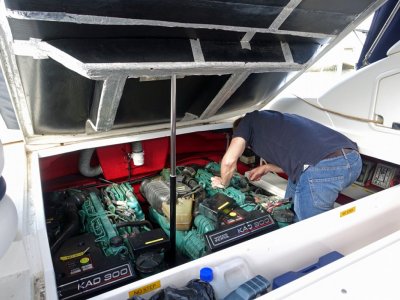
On a small trailer boat, it can be as simple as checking the make and model of the engine fitted to the boat and referencing the owner’s manual, though don’t forget about the boat trailer, since trailer and braking systems need regular maintenance and should be inspected at the same time as your engine. On a large motor yacht, you may have a number of engines, generators, gearboxes, water makers and other equipment onboard, each requiring servicing and having separate owner’s manuals to investigate.
As a general rule of thumb, most recreational marine engines recommend yearly service intervals or every 100 hours, whichever comes first. Don’t be fooled into thinking that if you haven’t used the boat you don’t need to service it, because annual servicing is still recommended even if you haven’t clocked up the hours. Some larger diesels can include bi-annual or 200 hour intervals. The more horsepower the engine is putting out relative to its displacement, the more regular and involved the service intervals will be.
What are some common items you will find in an annual periodic maintenance schedule?
Some of these will vary depending on the type of engine or gearbox, but here are some common things to find:
Annually:
- Replacement of engine oil and filters
- Replacement of gearbox oil
- Replacement of fuel filters
- Replacement of impellor
- Replacement of anodes
- Removal of sterndrive or gearbox, and inspection of universals or bellows
- Grease components
- Inspection of spark plugs
- Inspection of belts
2-10 Years
- Cleaning of saltwater cooling systems, such as heat exchangers, after coolers, oil coolers and seawater strainers
- Inspection of thermostats and coolant caps
- Replacement of coolant
- Replacement of water and oil seals in water pumps, gearboxes and engines
- Replacement of timing belts
- Checking valve tolerances
- Replacement of perishables such as belts and hoses
- Torquing of engine mounts, cylinder heads and exhausts
- Bleeding and replacing hydraulic oils in steering and hydraulic systems
- Servicing skin fittings and sea cocks
This is not an exhaustive list, and it’s always best to reference your owner’s manual for specific information about what needs maintenance and when.
What else can I learn from the Service History?
A boat owner is most likely to do either regular preventative maintenance or breakdown maintenance. When reviewing invoices from repairers, it’s good to read the entire invoice, since they often leave notes about any concerns or directions they may have received from the owner.
Preventative or Scheduled Maintenance
Preventative or scheduled maintenance is the preferred type, where the owner has been following a service protocol as specified by the manufacturer in the periodic maintenance schedule of the owner’s manual. Following a good scheduled maintenance plan will also increase the value of your boat when it’s time to sell, as it instils confidence in the person purchasing. Our guide on how much does it cost to maintain a used boat gives you a realistic picture of what properly maintained boats at different sizes and ages should be costing their owners annually.
Breakdown Maintenance
Breakdown maintenance is the least preferred type. It’s when the boat has broken down and been unable to operate without repairs, and is often carried out when the boat has been left unmaintained for long periods of time. For example, if you notice service receipts for items such as starter motors, batteries and alternators on low-hour boats, it’s likely because they’ve got wet due to neglect and had to be replaced.
Overall, a well-maintained boat has many merits, including increased value, peace of mind and much less chance of causing you and your family issues while out boating.
About The Author
After a decade repairing engines as a Marine Mechanic, Aaron O’Donoghue’s passion for boating grew into a Marine Surveying business called BoatBuy. With a team of Marine Surveyors and Engineers, Aaron personally assesses over 200 used boats boats each year.
Frequently Asked Questions
What’s the easiest way to find a boat’s service history?
The easiest option is if the current owner has documented it with receipts or a logbook. If that’s missing, contact the dealership for the boat or engine make, since popular brands such as Volvo, Mercury, Yamaha, Suzuki, Caterpillar and MAN keep online portals logging dealer services and recalls.
How often should a recreational boat engine be serviced?
Most recreational marine engines recommend yearly service intervals or every 100 hours, whichever comes first. Annual servicing is still recommended even if you haven’t clocked up many hours.
What’s the difference between preventative and breakdown maintenance?
Preventative or scheduled maintenance follows the manufacturer’s recommended service protocol and increases buyer confidence and resale value. Breakdown maintenance happens after the boat has already failed, often due to a long period without proper upkeep.
Does my boat trailer need servicing as well as my boat's engine?
Accordion body…
What warning signs in a service history suggest a neglected boat?
Service receipts showing replacement of starter motors, batteries and alternators on a low-hour boat can be a red flag, since these failures often happen because components have got wet due to neglect.